Fast-paced corporations often treat employees like replaceable cogs the second a deadline looms. When the pressure spikes, managers default to rigid, top-down directives to force productivity. The result? Disengaged teams, sub-par work, and rapid turnover. The solution to outsmarting the churn isn't a new project management tool or an AI productivity hack. It is Situational Leadership—a framework from 1969 that, if followed correctly, scales human empathy to build resilient, highly-engaged, sustainable teams that keep producing.
By Erin Smith, Human Resources Manager

At Metajive, in manager 101 training, we teach our managers to start with context. Here is why taking the time to meet employees exactly where they are changes everything about how we work.
Situational Leadership, primarily developed by Ken Blanchard and Paul Hersey, is based on a simple premise: there is no single "best" style of leadership. The most effective leaders adapt their approach based on the specific needs of the person they are managing and the specific task at hand. You don't manage a 10-year veteran the same way you manage a new hire, and you adapt your style when that veteran takes on a completely unfamiliar project.
To apply this, a leader must evaluate the employee's Development Level (Competence and Commitment) and adjust their Leadership Style (Directive vs. Supportive behavior) across four distinct stages:
- D1 / S1 (The Enthusiastic Beginner & Directing): Low competence but high commitment. The employee doesn’t know what they don’t know. The leader provides specific instructions and close supervision.
- D2 / S2 (The Disillusioned Learner & Coaching): The initial excitement has worn off, and the work is much harder than expected. The leader provides high direction but heavily increases emotional support.
- D3 / S3 (The Capable but Cautious Performer & Supporting): The employee has the skills but lacks confidence or motivation. The leader steps back from day-to-day instruction and focuses on collaboration and reassurance
- D4 / S4 (The Self-Reliant Achiever & Delegating): High competence and high commitment. The leader delegates decision-making and stays out of the way.
The ultimate goal of a manager is to accurately diagnose where an employee sits on this scale for any given task and seamlessly adapt. Yes- this is task-based and not person or position-based. And diagnosing what’s going on with an employee doesn’t happen in a vacuum, by hearsay, or by observation alone.
In a fast-moving agency, the number one red flag that a manager is failing to read the context is the employee's initial reaction to the manager’s feedback and their subsequent approach to the work. Is the employee shutting down or annoyed? In their work on this task, are they “phoning it in” or whatever the kids are calling it these days? This can be misaligned management.
Often, managers don't ask enough questions. They make assumptions about where an employee is at, or cast judgment. We humans all do this. And I get it, we’re pressed for time, bombarded with information, pushed to be more efficient, and honest conversations can be awkward, uncomfortable! But having the conversation is key. And aligning your leadership style to where the employee is at is also key. When a manager applies an S1 (Directing) style to a D3 (Capable) employee, it feels like micromanagement and often condescension. And when they apply an S4 (Delegating) style to a D2 (Disillusioned) employee, it feels like abandonment. The equivalent of telling a new hire to “just figure it out” on their first day!
When feedback lands wrong, without repair, it damages the relationship. The employee distances themselves, engagement drops, and productivity stalls. Sometimes employees quit. We train our managers to catch these assumptions early and adjust. We coach our managers to be curious, ask more questions, and truly understand what matters to their employees and not just what, but how they are doing during any given week. Our managers having their fingers on the pulse of their team is our superpower.

We pay special attention to the D2 and D3 stages during our manager training, as these are the critical phases where retention is won or lost.
When an employee hits the D2 "Disillusioned Learner" phase, the worst thing a manager can do is take the keyboard away and fix the problem themselves or reassign the project to someone more experienced. Instead, we teach our managers to lean in. They must practice active listening, let the employee vent, and then empathize with exactly where they are at. Managers will often share an anecdote from their past experience to show that they’ve been there. We sit in it with them. And employees don’t forget these moments.
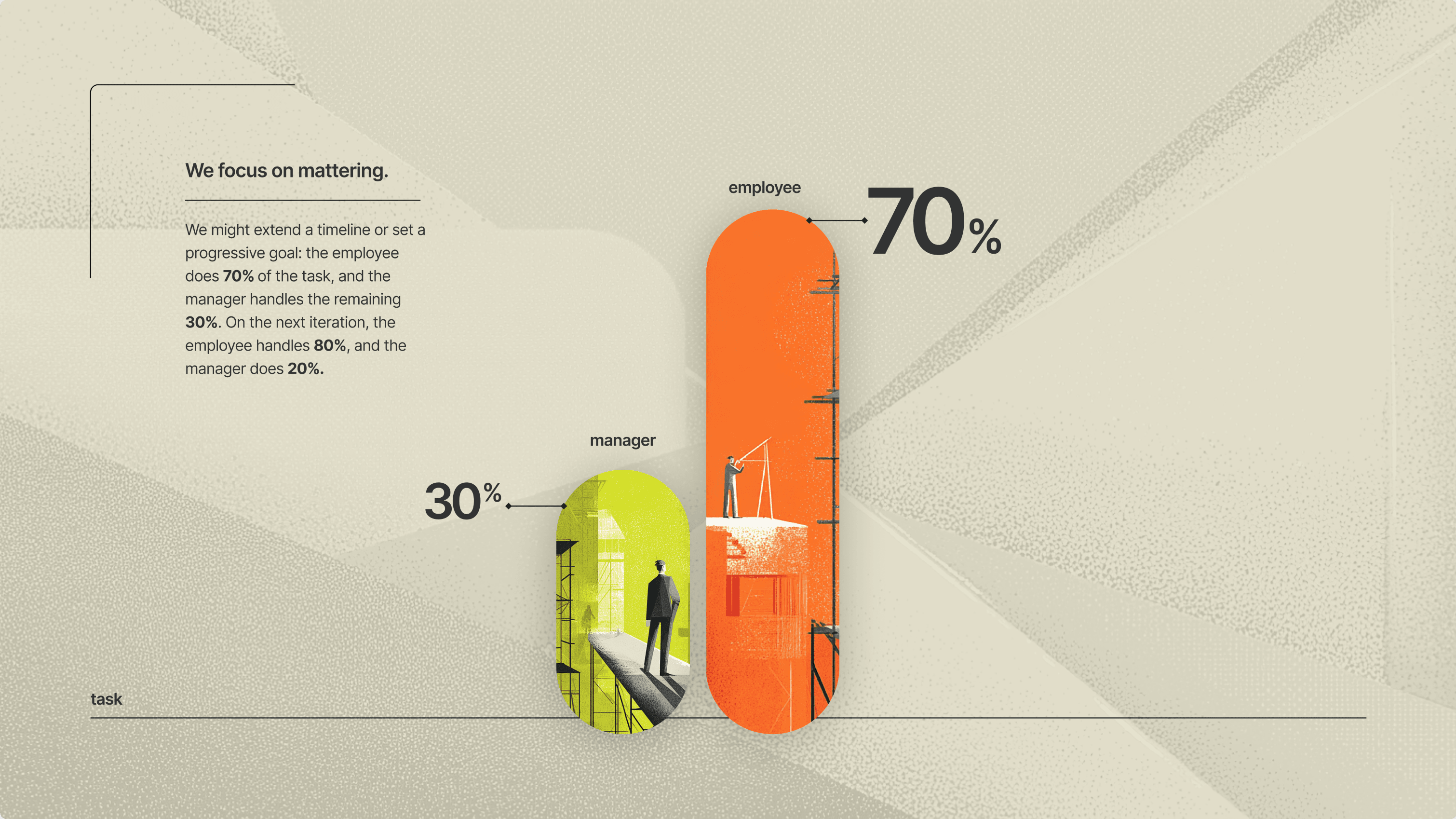
We focus on mattering. We let the employee know that they matter to the team and that we believe they can do the work. Then, we partner with them, plan, and execute. We might extend a timeline or set a progressive goal: the employee does 70% of the task, and the manager handles the remaining 30%. On the next iteration, the employee handles 80%, and the manager does 20%. We build them back up until they are operating independently, setting them up to succeed and celebrating that growth.
Meeting an employee where they are at takes empathy, curiosity, and time. It is a step that cannot be skipped.
In a digital world, it is incredibly easy for companies to focus purely on utilization rates. But our people are our biggest asset. The human touch makes all the difference in this digital, automated information age of geographically dispersed teams. Cultivating deep trust and proving to employees that they matter, even in micro-moments, leads to a level of empowerment that can 10x your productivity indefinitely before you even introduce AI into the workflow.
Investing in employees on a personal level is the seed that starts a vibrant culture; the benefits ripple outward from the individual employee to the entire organization. At Metajive, this looks like sending handwritten cards and care packages through the mail. It means getting in the trenches with our teams when it counts and volunteering to help - sometimes at the eleventh hour. It means spending time every week on virtual calls, specifically recognizing and thanking individuals for their contributions, and maintaining consistent, thoughtful one-on-ones with feedback. One-on-ones are sacred. And Situational Leadership is a must. In business terms, the benefits of this include: higher employee retention, a stronger leadership pipeline that makes succession planning easy, promotions from within, increased overall productivity, engagement, and growth. If you think AI is a force multiplier, try coupling it with the legacy you inherit from managers who build trust and use Situational Leadership effectively.
Because this approach requires a high baseline of emotional intelligence, we protect it fiercely during the hiring process.
When bringing in new managers, we don't just look at their portfolios. We rely on rigorous behavioral interviews. We ask for specific examples of how they handle team friction, how they deliver and receive feedback, and what their default management style looks like under pressure. We call past bosses and past employees to conduct thorough reference checks. But we all know that making a great hire isn’t an exact science. So we lean on our team.
Once hired, the work doesn't stop. The 30- and 90-day check-ins are crucial. We gather peer and employee feedback to ensure our new leaders aren't just hitting deadlines, but are actively building the trust and rapport that keeps our teams thriving.