From product data to protocol compliance, we build the commerce infrastructure AI agents will need to read, evaluate, and buy from your catalog. Metajive combines strategy, data architecture, and development to prepare your store for the agentic shelf before it goes live. We handle structured data implementation, UCP and ACP integration, Shopify Agentic Storefront configuration, and LLM-optimized content, so you launch ready, not scrambling.
The challenge
Agentic commerce is arriving fast. Google's UCP, OpenAI's ACP, and Shopify Agentic Storefronts are rolling out now, and most commerce infrastructure was never built for machine-driven purchasing. Your product data speaks to humans, not agents. Schema markup is incomplete, checkout is not protocol-compliant, and your catalog is not structured for the AI-driven discovery that is about to go mainstream. The brands that prepare now will own the positions competitors scramble for later. You need a partner with the data expertise, protocol knowledge, and technical depth to get you there first.
Key Services
We develop a phased implementation roadmap tailored to your platform, category, and competitive landscape. We prioritize quick wins (structured data, Shopify enablement) alongside long-term protocol integration goals.
We assess your product data, checkout infrastructure, and protocol compatibility against emerging AI agent requirements from Google, OpenAI, and Shopify. You receive a scored assessment with a prioritized implementation roadmap.
We implement monitoring to distinguish AI agent traffic from human traffic, track agent conversion paths, and measure which agents surface your products as agentic channels scale.
We implement comprehensive Schema.org markup in JSON-LD across your product catalog. This includes MerchantReturnPolicy, ShippingDetails, hasMeasurement, and material properties that AI agents will evaluate before making purchasing decisions.
We optimize your product descriptions, FAQs, and brand content for extraction and citation by large language models. Structured for Answer Engine Optimization (AEO) across ChatGPT, Gemini, and Perplexity.
We integrate your commerce infrastructure with Google's Universal Commerce Protocol (UCP), enabling AI-driven transactions through Google Search AI Mode and Gemini. We configure native checkout or embedded checkout paths based on your regulatory requirements.
We build the REST API endpoints required for OpenAI's Agentic Commerce Protocol (ACP), connecting your backend to ChatGPT Instant Checkout via Stripe payment tokenization. Secure, compliant, and built to spec.
We configure and optimize your Shopify Agentic Storefront sales channel, structuring your catalog for maximum visibility across ChatGPT, Microsoft Copilot, Perplexity, and Google AI surfaces.
We restructure your product attribute taxonomy for machine consumption. Marketing-driven attributes like "Midnight Mystery" become standardized, agent-parseable data: "Dark Blue, hex #00008B." Clean data means agent visibility.
We establish and verify your brand entity across Wikidata, Crunchbase, and Google Knowledge Graph. AI agents will reference these trusted sources to confirm brand legitimacy before recommending products to users.
We build agent-facing REST API endpoints with UCP-compliant JSON output, proper header configuration (X-Agentic-Protocol: UCP/1.0), and edge caching strategies to handle high-velocity agent traffic without performance degradation.











The Metajive solution
Preparing for agentic commerce should not start with a template or a strategy deck. Metajive brings the data architecture expertise to structure your catalog for machines, the engineering depth to integrate with UCP and ACP protocols, and the commerce experience to optimize for agent-driven conversion before the channel matures. One team, every layer, no handoffs between strategists, developers, and data architects. Why coordinate three vendors when you can start with a partner who handles the full stack?
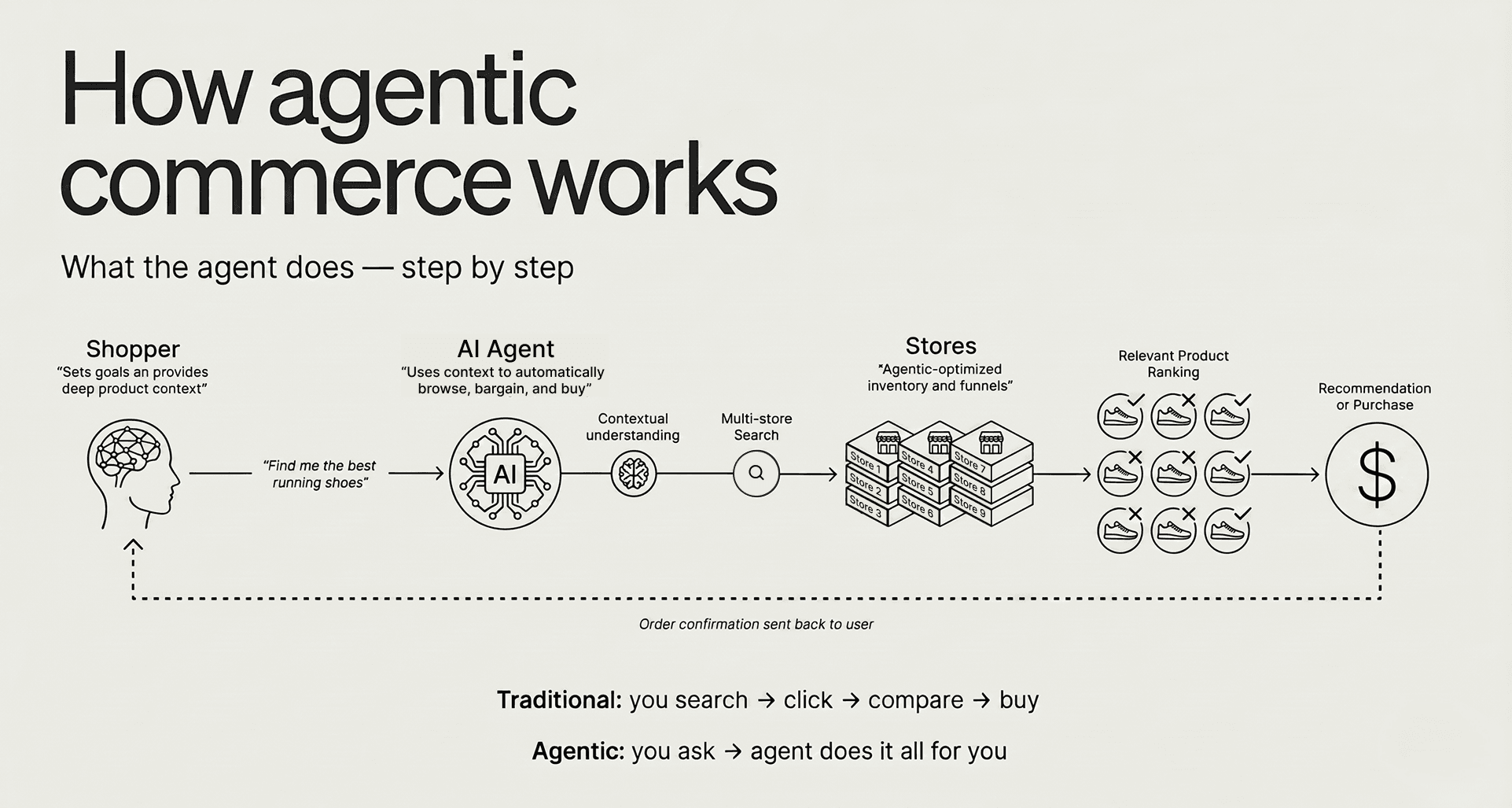
Agentic commerce is the emerging shift from human-driven online shopping to AI agent-driven purchasing. AI agents from Google, OpenAI, and Shopify are being built to autonomously discover, evaluate, and buy products on behalf of consumers. Instead of browsing a storefront, agents will query structured data and commerce protocols to complete transactions. Brands that make their product information machine-readable now will be first in line when these channels scale.
Traditional ecommerce is built for human shoppers who browse, click, and visually evaluate products. Agentic commerce is built for AI agents that parse metadata, query APIs, and filter on structured attributes like price, composition, and return policies. The key difference: agents will not see images or read marketing copy. They will evaluate data. Brands that optimize only for human experience will be overlooked when agent-driven transactions go mainstream.
Google's Universal Commerce Protocol (UCP) is an open standard for product discovery and transactions across Google Search AI Mode and Gemini. OpenAI's Agentic Commerce Protocol (ACP) is designed for conversational checkout within ChatGPT, using Stripe for payment tokenization. UCP focuses on search-driven discovery. ACP focuses on chat-driven closure. Both protocols are in early rollout, and most brands will need both to capture the full range of agent-driven commerce.
Start with three foundations. First, implement comprehensive Schema.org/JSON-LD structured data across your product catalog, including return policies, shipping details, and material composition. Second, standardize product identifiers (GTIN/GS1) so agents can verify products across platforms. Third, integrate with commerce protocols (UCP and ACP) to enable agent-driven transactions. A readiness audit identifies your specific gaps and prioritizes the implementation sequence.
Yes. Shopify launched Agentic Storefronts as a native sales channel in early 2026. Once enabled, your products become discoverable and purchasable through ChatGPT, Microsoft Copilot, Perplexity, and Google AI surfaces. However, enabling the channel is only the first step. Optimizing your product data, attributes, and structured markup determines how well agents evaluate and recommend your products compared to competitors.
Look for five capabilities:
- Full-stack delivery (strategy, data architecture, and development in one team)
- Protocol expertise (hands-on experience with UCP and ACP integration)
- Shopify partnership and platform-level knowledge
- Compliance credentials (SOC II, data governance, payment security)
- Enterprise experience with complex, multi-system commerce environments
You lose first-mover advantage in a channel that rewards early preparation. As competitors integrate with commerce protocols and structure their data for agents, they will capture the positions agents recommend first. Unlike traditional SEO, where rankings shift gradually, agentic commerce will favor early movers with compound advantages. The brands that build infrastructure now will be entrenched in agent recommendation logic before latecomers even begin.